
-
7010045702
Conveyor Manufacturers in Chennai
What is a Conveyor?
A conveyor is a mechanical device utilized for the transportation of materials from one location to another. According to the American Society of Mechanical Engineers, a conveyor is defined as a “horizontal, inclined, or vertical apparatus for moving or transporting bulk materials, packages, objects, or passengers along a path predetermined by the device's design.” A crucial aspect of this definition, which distinguishes conveyors from other material handling equipment, is their ability to transport products along a path that is "predetermined by the design of the device." This characteristic is common to all types of conveyors, regardless of their specific application, industry, or sector. While many conveyors, particularly those used in sorting systems, can redirect products in multiple directions, all these routes are predetermined.
Conveyors find applications across various sectors, including industrial, commercial, retail, agriculture, and mining. They are also increasingly being adopted in the hospitality and construction industries.
The Basic Components of Conveyors
Most conveyors consist of three fundamental components: a frame or belt support, a drive mechanism, and one or more idlers.
The most prevalent type of conveyor, in its simplest form, is the end drive belt conveyor, commonly seen at grocery store checkout counters. This configuration includes a frame with a driven pulley or drum at one end and an idler pulley or drum at the opposite end, with an endless belt looping around both pulleys and the frame. Typically, the driven pulley is powered by an external electric motor.
However, there are variations to this basic conveyor design.
Conveyors can transport products in a straight line, either horizontally or vertically, and can also be designed with corners or radius sections to facilitate movement in two or three dimensions.
Advantages of Conveyor Systems:
Conveyor systems present numerous benefits compared to manual material handling:
Enhanced Efficiency: These systems automate the movement of materials, significantly boosting operational speed and efficiency. By ensuring a consistent and rapid flow of goods, conveyor systems enable businesses to better achieve production goals and meet deadlines.
Increased Safety: By automating the transport of heavy or hazardous materials, conveyor systems lower the likelihood of workplace injuries, fostering a safer working environment. They also reduce the need for human interaction with dangerous machinery and materials, thereby improving overall safety standards.
Cost Reduction: The automation provided by conveyor systems leads to decreased labor costs and fewer errors, resulting in substantial long-term savings. Furthermore, modern conveyor systems are built for longevity and require minimal maintenance, which helps to lower ongoing maintenance costs.
Versatility: Conveyor systems can be tailored to meet specific operational requirements, accommodating a variety of load types, sizes, and shapes. They can be easily reconfigured or expanded to respond to evolving production needs, ensuring their continued effectiveness.
Improved Ergonomics: Conveyor systems promote proper posture and lessen physical strain on workers, contributing to a healthier workplace. By automating repetitive tasks, they also reduce the risk of musculoskeletal disorders and enhance worker productivity.
Effective Inventory Management: Conveyors facilitate the smooth movement of materials through different production stages, improving inventory oversight and minimizing bottlenecks. This streamlined process enhances tracking accuracy and reduces delays, leading to a more agile supply chain.
Space Efficiency: Conveyor systems can be designed to make use of vertical space, optimizing floor area for other operations. This effective space utilization supports increased throughput and can accommodate future growth without necessitating significant modifications to the facility.
Industries that employ conveyor systems include:
Manufacturing: Conveyor systems play a vital role in the efficient transportation of raw materials, components, and finished products throughout the production process. They facilitate both continuous and batch operations, enhance workflow, minimize manual handling, and boost overall productivity, thereby ensuring timely product delivery.
Food and Beverage: These systems are essential for transporting ingredients and packaged items while upholding hygiene standards. They help maintain compliance with health regulations, mitigate contamination risks, and support rapid processing and packaging to satisfy consumer demand.
Mining and Heavy Industries: Conveyor systems are utilized to transport substantial volumes of bulk materials, including coal, ores, and minerals. They are indispensable for material extraction, processing operations, and the movement of materials to stockpiles.
Warehousing and Distribution: Conveyor systems streamline the movement of goods within expansive storage facilities, aiding in sorting, packing, and shipping processes. They enhance space utilization, improve inventory management, and accelerate order fulfillment.
Types of Conveyor Systems:
The extensive array of conveyor systems provides solutions tailored to various material handling requirements. Below are some of the most prevalent types:
Belt Conveyors
Belt conveyors are the most widely utilized type, featuring a continuous belt that facilitates the movement of materials. They are particularly effective for transporting products of diverse shapes and sizes over extended distances. Commonly found in sectors such as food processing, manufacturing, and mining, these conveyors can be constructed from various materials, including rubber, PVC, and fabric, allowing for customization to meet specific application needs. Furthermore, they can be engineered with different inclines and curves to accommodate intricate layouts.
Roller Conveyors
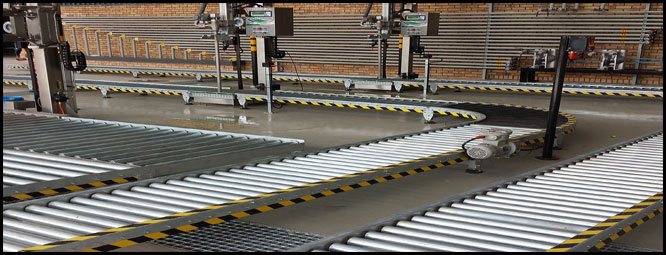
Roller conveyors comprise a series of rollers that enable items to be moved either manually or by gravity. They are well-suited for the transportation of heavier goods and are frequently employed in packaging and assembly lines. These conveyors can be either powered or non-powered (gravity conveyors) and offer significant flexibility, making them easy to integrate into existing systems. They are commonly used in industries such as automotive, warehousing, and logistics, and their modular design allows for straightforward expansion and reconfiguration as necessary.
Chain Conveyors
Chain conveyors utilize chains to transport products along the production line, making them ideal for heavy-duty applications such as automotive manufacturing. Renowned for their robustness and capacity to handle substantial loads, chain conveyors are perfect for moving pallets, containers, and large industrial components. They are often employed in challenging environments where other conveyor types may not perform effectively. Their design can be tailored with various chain types and configurations to satisfy specific operational requirements.
Pneumatic Conveyors
Pneumatic conveyors utilize air pressure to transport materials through tubes, making them ideal for the movement of bulk materials such as powders and granules. These systems are particularly well-suited for environments that demand cleanliness and minimal dust, including the pharmaceutical, food processing, and chemical manufacturing industries. Pneumatic conveyors can be designed for both dense and dilute phase conveying, providing flexibility in handling various material types. Additionally, they offer the capability to navigate complex layouts, enhancing routing options for material transport.
Overhead Conveyors
Overhead conveyors operate on elevated tracks to transport items, thereby maximizing floor space and improving the efficiency of the available area. Commonly found in manufacturing facilities, automotive assembly lines, and paint shops, these systems can accommodate a wide range of loads, from lightweight products to heavy components. They are especially advantageous in settings where space is limited or where items must be moved over considerable distances without disrupting operations at ground level. Furthermore, these conveyors can be engineered to transport products across different elevations and around obstacles.
Key considerations for conveyor systems:
Design and customization: Choosing the appropriate conveyor system requires a thorough understanding of your operational requirements and tailoring the system to meet those needs. This process involves selecting the correct type of conveyor, assessing the necessary load capacity, and ensuring it integrates seamlessly with existing machinery.
Installation and assembly: Effective installation and assembly of the conveyor system are vital for achieving optimal performance. This entails accurate alignment, secure connections, and comprehensive testing to confirm that the system functions efficiently and safely.
Safety features: Prioritizing safety is essential. It is important to ensure that the selected conveyor system adheres to safety standards and incorporates protective measures such as emergency stop mechanisms.
Maintenance and support: Consistent maintenance is crucial for the efficient operation of conveyor systems. This includes regular inspections, prompt repairs, and the replacement of any worn components. Collaborating with skilled service providers can help maintain your system in excellent working order.
Scalability: As your business expands, your conveyor system should be capable of adapting accordingly. Modular designs and expandable elements can facilitate the accommodation of increased production demands and evolving operational requirements.
⦿ Recuperate fine appealing particles
⦿ Adaptable appealing recovery choices available
⦿ Various pass structures contemplate little impression
⦿ Singular move speed change and continuous speed watching licenses headway control
⦿ Residue extraction impeccable to allow safe and earth agreeable undertaking
Magnetic Roll Separator Manufacturers in Chennai
MAXWELL INDUSTRIES produces Magnetic Roll Separators. It is of high power and tendency. It is used for current mineral applications. It joins high-imperativeness unprecedented earth neodymium enduring attractive roll get together which is delivered and amassed to make appealing field to the solicitation of 24,000 Gauss. Under this high power attractive field, weakly attractive iron contaminants can be successfully removed profitably. It finds applications in treatment of grinding, unshakable and terminated rough materials, glass unrefined materials; and cleaning silica sand, quartz, feldspar, dolomite and various metals and minerals, plastic rough materials.
Attractive move separators offered comes in the quality improvement, finish and discover expansive use in achieving consistent extraction of minimal attractive particles from explicit minerals. The use of these sorts of appealing separators assurances of keeping up high mineral perfection and discovers wide use in industry divisions like masterful and mineral dealing with organizations.
The working methodology of these move separators incorporates treating the material treated, continued from a compartment/vibratory feeder at a controlled rate on a powerful magnet that empowers an attractive material to propel associated with move face and other non-attractive material being started the face at the common bearing


Conveyor Manufacturers Keywords
#conveyormanufacturerschennai
#beltconveyormanufacturerschennai
#ssconveyormanufacturerschennai
#stinlesssteelconveyormanufacturerschennai
#industrialconveyormanufacturerschennai
#conveyorsystemmanufacturerschennai
#magneticconveyormanufacturerschennai
#rollerconveyormanufacturerschennai
#telescopicconveyormanufacturerschennai
#chainconveyormanufacturerschennai
#automaticconveyormanufacturerschennai
#materialhandlingconveyormanufacturerschennai
#overheadconveyormanufacturerschennai